Tuesday, September 28th, 2010 
 Nachman Ben Yehuda is an old friend. We were graduate students together at the University of Chicago. He, his wife Etti, my wife Naomi and I have been friends ever since. He is now a professor of sociology at the Hebrew University in Jerusalem, the author of books that explore the worlds of deviance and the unsteadiness of memory about things political. Jewish assassins, the “Masada myth,” betrayal and treason, and as he puts it talking about his most recent book Theocratic Democracy, “pious perverts” are the subjects of Nachman’s sociological curiosity. On their recent visit to New York, we got together for a visit to the Museum of Modern Art, to see the exciting Matisse: Radical Invention, 1913–1917 exhibit. While walking through the museum, I asked Nachman about the Park 51, about Cordoba House. Nachman is now back in Jerusalem, but emailed me his recollection of our discussion, which I thought would be good to share here. Nachman Ben Yehuda is an old friend. We were graduate students together at the University of Chicago. He, his wife Etti, my wife Naomi and I have been friends ever since. He is now a professor of sociology at the Hebrew University in Jerusalem, the author of books that explore the worlds of deviance and the unsteadiness of memory about things political. Jewish assassins, the “Masada myth,” betrayal and treason, and as he puts it talking about his most recent book Theocratic Democracy, “pious perverts” are the subjects of Nachman’s sociological curiosity. On their recent visit to New York, we got together for a visit to the Museum of Modern Art, to see the exciting Matisse: Radical Invention, 1913–1917 exhibit. While walking through the museum, I asked Nachman about the Park 51, about Cordoba House. Nachman is now back in Jerusalem, but emailed me his recollection of our discussion, which I thought would be good to share here.
A Conversation Remembered
He recalled our conversation:
The mosque. If I remember correctly our conversation, my argument was that officially and legally, there is no doubt that there is absolutely nothing wrong with the initiative to build the mosque where planned and that President Obama as defender of the American constitution did the right thing when he made his speech and supported it. My concern was as a hopeless symbologist and on the symbolic level. Hence, having said that legally Muslims are within their constitutional rights, I was concerned whether it was absolutely necessary or wise to have a Muslim mosque so close to where radical Muslims massacred thousands of innocent Americans. You put my concern there to rest.
In our discussion, I essentially made the argument I have been making in posts here, most crucially my first one considering the raw facts , but also my more recent post The tragedy of Imam Feisal Abdul Rauf. My key point, which convinced Nachman, was that the Cordoba House was actually a respectful initiative, made by people of good will, who sought respectful dialogue between Muslims and their fellow Americans. Yet, Nachman still . . .
Read more: Talking about Cordoba
Sunday, September 26th, 2010
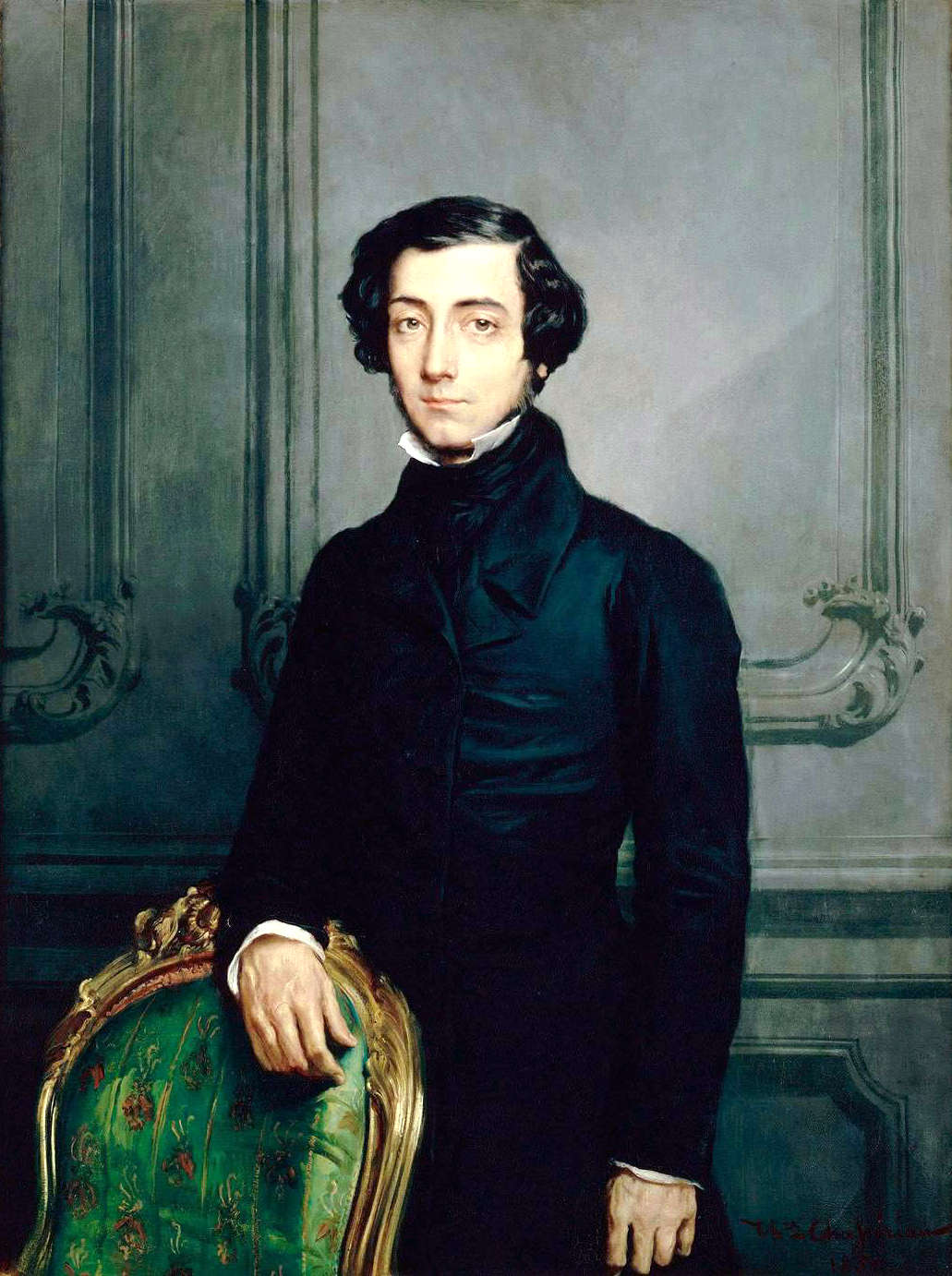 Although I mostly teach graduate students, I teach one course a year in the liberal arts college of the New School, Eugene Lang College. In my course this year, we have been closely reading Tocqueville’s Democracy in America, freely discussing his topic, the American democratic experience. My goal for the class is to go back and forth, between close reading and informed discussion. Although I mostly teach graduate students, I teach one course a year in the liberal arts college of the New School, Eugene Lang College. In my course this year, we have been closely reading Tocqueville’s Democracy in America, freely discussing his topic, the American democratic experience. My goal for the class is to go back and forth, between close reading and informed discussion.
Of the two volumes in Tocqueville’s classic, I enjoy most reading and discussing Volume 2, which is more a critical examination of the promise and perils of democracy and its culture, less about the institutional arrangements and inventive practices of the Americans, which Tocqueville celebrated and which is the focus of Volume 1 of his masterpiece. But this year, Volume 1 has become especially interesting to me. I hope for the students also.
I have taught the course many times. The way it develops always depends upon what’s going on in the world, who is in the class, and how they connect their lives with the challenges of Tocqueville. We don’t read Tocqueville for his insights and predictions about the details of American life, judging what he got right, what he got wrong. Rather, we try to figure out how his approach to the problems of democracy can help us critically understand our world and his, democracy in America back then and now.
Assigning the Constitution 
This semester, indeed, for the past two weeks, the course has taken an interesting turn. As we have been reading Tocqueville on the American system of government, political associations and freedom of the press, i.e. Volume 1, Parts 1 and 2, I felt the need to assign an additional shorter reading, The Constitution of the United States of America. I did this not because I feared that the students hadn’t yet read this central document in the story of democracy in America and beyond (they had), but because I judged that it was time to re-read the text, to note what is in it and what is not, to critically appraise the use of the document as a confirmation of the partisan . . .
Read more: The Constitution and American Political Debate
Friday, September 24th, 2010 
In my previous research, I’ve examined how local arts movements can have a big impact on regional politics.

There was an interesting article in The New York Times last Sunday about a poetry salon in Damascus, Syria. It reminded me of the theater movement I studied in Poland in the 1970s. Both the theater movement and the poetry salon are examples of constituted free zones in repressive societies. I think they demonstrate the possibility of re-inventing political culture, the possibility of reformulating the relationship between the culture of power and the power of culture.
The secret police are present at Bayt al-Qasid, the House of Poetry, in Damascus today, The Times reports, but it is also a place where innovative poetry is read, including by poets in exile, politically daring ideas are discussed, a world of alternative sensibility is created. Not the star poets of the sixties, but young unknowns predominate. The point is not political agitation nor to showcase celebrity, but the creation of a special place for reading, performance and discussion of the new and challenging. The article quotes a patron about a recent reading. “‘In a culture that loathes dialogue,’ the evening represented something different, said Mr. Sawah, the editor of a poetry Web site. ‘What is tackled here,’ he said, ‘would never be approached elsewhere.’”
Cynics would say that the Polish theater and the Syrian salon are safety valve mechanism, through which the young and the marginal can let off steam, as a repressive political culture prevails. But in Poland, the safety valve overturned the official culture, even before the collapse of the Communist regime, as I explained in my book Beyond Glasnost: the Post Totalitarian Mind.
I don’t want to assert that this happy ending is always the result of such cultural work. Clearly, it’s not. But I do want to underscore that the very existence of an alternative sensibility in a repressive context changes the nature of the social order. Poland was not simply a repressive country then, and Syria is not simply repressive now. They are . . .
Read more: In Syria: Poetry Salon Provides Release, Freedom
Friday, September 24th, 2010
 Andrew Arato is an expert in constitutions, a pressing topic in Turkey right now. Andrew Arato is an expert in constitutions, a pressing topic in Turkey right now.
I read the news about the Turkish referendum on constitutional reforms with great interest. Turkey is a bridge between East and West. Europe meets Asia in modern booming Istanbul. It’s a place where the commitment to democracy and to an open Islam is the official policy of the governing Justice and Development Party. It’s a place of great hope and promise, where instead of the clash of civilizations, there is dialogue and reinvention. But it is also a place where people committed to secularism worry about the prospects for their modern way of life. I tried to follow the news reports about what happened, but they were unclear. I understood that a sweeping package of constitutional reforms were approved, that the referendum purported to bring the Turkish constitution up to European standards, but also that the opposition was claiming that the package was a systematic power grab. Is this a sign of democratic progress as the ruling party spokesman declared, or is it, as the opposition declared, a significant regression? I called my friend and New School colleague, Andrew Arato, a distinguished expert on constitutions, who has been working with a group of young scholars on constitutional issues in Turkey. He agreed to answer my questions. I opened by asking him whether the referendum results were good or bad news?
I think bad. The successful Turkish referendum of September 12 was ultimately about court packing. Not only is the manner of choosing judges for the Court now altered, but six new judges presumably friendly to the government will be added to the Court within 30 days.
This is a point missed by almost all Western commentary on the event. Court packing is always bad business. The way is now almost open for the AKP (Adalet ve Kalkınma Partisi, the ruling Party with leaders who have an Islamist, but are committed to membership in the European Union) to remake the country’s secular constitution entirely on its own.
 . . . . . .
Read more: Politically Weighted Courts in Turkey “Bad News” for Democracy
Wednesday, September 22nd, 2010
The man behind the controversial Islamic Community Center in lower Manhattan, Feisal Abdul Rauf, aims for tolerance, but stirs up fear and regret.
 While I have been observing Feisal Abdul Rauf’s actions and reactions to the public controversies surrounding his work as the the chairman of the Cordoba Initiative and the imam of the Farah mosque in Lower Manhattan, I have been thinking a lot about my book, Civility and Subversion: The Intellectual in Democratic Society. I think that in democracies, intellectuals are talk provokers who help the general public confront and address serious political problems by informing discussion. I think that they do so by civilizing differences so that enemies can become opponents and opponents can become collaborators, and by subverting commonsense that hides problems, so that these problems then can be discussed. I, of course, know that no one intellectual is always a subversive, and no one intellectual is always an agent of civility. Yet, certain key intellectuals have primarily played one or the other role. This for example is how I think about the intellectual work of Malcolm X versus Martin Luther King Jr. While I have been observing Feisal Abdul Rauf’s actions and reactions to the public controversies surrounding his work as the the chairman of the Cordoba Initiative and the imam of the Farah mosque in Lower Manhattan, I have been thinking a lot about my book, Civility and Subversion: The Intellectual in Democratic Society. I think that in democracies, intellectuals are talk provokers who help the general public confront and address serious political problems by informing discussion. I think that they do so by civilizing differences so that enemies can become opponents and opponents can become collaborators, and by subverting commonsense that hides problems, so that these problems then can be discussed. I, of course, know that no one intellectual is always a subversive, and no one intellectual is always an agent of civility. Yet, certain key intellectuals have primarily played one or the other role. This for example is how I think about the intellectual work of Malcolm X versus Martin Luther King Jr.
The tragedy of Feisal Abdul Rauf is that he has intended and has dedicated his life to the role of civility, while more brutal figures in our public life, perhaps Newt Gingrich is the primary culprit, have intended to turn the persistently patriotic imam into a subversive. He has been labeled an agent of Islamic, indeed radical Islamist, subversion of the good moral order, just when he has done everything in his public pronouncements and actions to support the good pluralistic moral order that he understands, along with many of his fellow Americans including his President, to be the great American achievement.
Thus consider deliberately Feisal Abdul Rauf’s words in his recent op-ed piece. He is even willing to see this episode in which he has been systematically and viciously slandered as a positive development in the project of civil religious interactions:
“Lost amid the commotion is the good that has come out of the recent discussion. I want to draw attention, specifically, to the open, law-based and tolerant actions that . . .
Read more: The Tragedy of Imam Feisal Abdul Rauf
Sunday, September 19th, 2010
I have been developing DC for the last 6 months or so, at first, mostly, just thinking about it, but more recently, intensively working on it, trying to figure out exactly what the project will be, working with Lauren Denigan, managing editor, to give the blog precise shape, and writing posts that respond to the events of the day, trying to utilize my full intellectual range, establishing a pattern of what I hope DeliberatelyConsidered.com will become.
This Tuesday, we went a step further. I introduced the project to some dear friends and colleagues at the annual opening party of the New School’s Transregional Center for Democratic Studies. The party was a pleasure, as it always is. I was especially pleased by the response to my developing blog, and the prospect that this will be the beginning of a beautiful relationship between TCDS and DC, a variation on an old theme.
TCDS and Me
The story of TCDS and my story are intimately connected. It’s an example of the politics of small things, in which I am one of the central actors. There is a long version and a short version. I’ll start the long by highlighting the short with some quick headlines, and hope that we can continue the story’s themes in this new setting.
 Elzbieta Matynia (who is the TCDS director) and I each worked on the sociology of theater in Poland, meeting there. More details about this time later, for now just note that a deep friendship between Elzbieta and my wife, Naomi, and me developed and has endured, through major international and personal crises, martial law in Poland, changes in our social and political circumstances. We developed parallel careers which met at the New School. When martial law was declared in Poland in 1981, Elzbieta’s one-year scholarship to study at our university became a lifetime relationship: first as a visiting scholar, then as an adjunct instructor, now as the Director of the Transregional Center and senior member of our Department of Sociology and Committee on Liberal Studies. Elzbieta Matynia (who is the TCDS director) and I each worked on the sociology of theater in Poland, meeting there. More details about this time later, for now just note that a deep friendship between Elzbieta and my wife, Naomi, and me developed and has endured, through major international and personal crises, martial law in Poland, changes in our social and political circumstances. We developed parallel careers which met at the New School. When martial law was declared in Poland in 1981, Elzbieta’s one-year scholarship to study at our university became a lifetime relationship: first as a visiting scholar, then as an adjunct instructor, now as the Director of the Transregional Center and senior member of our Department of Sociology and Committee on Liberal Studies.
The seeds of TCDS were planted when she and I met in Poland. It was firmly rooted in the mid . . .
Read more: DC and TCDS: Going Public by Bringing It Home
Sunday, September 12th, 2010

Max Weber, author of "Politics as Vocation"
It sometimes feels like Barack Obama has studied Max Weber’s classic, “Politics as a Vocation,” a bit too carefully. In his lecture, given in the aftermath of the tragedy of World War I, Weber made a strong distinction between an ethics of responsibility and an ethics of ultimate ends – between an ethics that is based in getting practical things done politically, serving one’s constituency’s interests and understandings, and an ethics of principled politics, true to one’s core values.
Such a distinction leads Obama to clearly distinguish between an ethics of responsible governance and an ethics of imaginative and eloquent political campaigning, including attractive depictions of ultimate ends. Obama’s reticence to use the poetry of campaigning, while he is engaged in the prose of governing, has meant that he hasn’t attacked those who have viciously attacked him. It is only now in campaign mode that he is responding. There are pressing questions: has his been a responsible approach? And has his position made Obama’s (and his supporters) ends more distant?
Thus, Brian Beutler, in a post on Talking Points Memo, applauded President Obama in his speech on the economy of September 8 in Cleveland for his direct attack on John Boehner, criticizing him “by name no less than eight times,” but laments “Complicating matters for Democrats is that, well, few Americans know who “Mr. Boehner” is. That might not be the case if Obama had given speeches like this starting a year ago. But there are still several weeks to go until election day.”
And Bob Herbert, in his op-ed. piece on Tuesday, was very pleased but also bewildered, “ Mr. Obama linked the nation’s desperate need for jobs to the sorry state of the national infrastructure in a tone that conveyed both passion and empathy, and left me wondering, ‘Where has this guy been for the past year and a half?’”
The Method to his Madness?
Yet, it should be understood that there is a method, or at least a significant strategic decision, to the President’s madness. He knew that he might need at least a . . .
Read more: Obama’s Dilemna: Responsible or Principled Politics?
Sunday, September 12th, 2010 The staff of DeliberatelyConsidered.com would like to join others around the world in remembrance of the losses suffered on September 11, 2001 and its aftermath.
Thursday, September 9th, 2010
I was planning to post today about the new peace talks between Israel and Palestine using the perspective of the politics of small things. But this will have to wait for another day. Barack Obama gave a speech on Labor Day that requires attention. It was a very strong partisan address, a forceful support of the labor movement on labor’s day, a clear proclamation of his position on the pressing issue of the day, the state of the economy, and on the strategy necessary to fix it.
The Storyline
 Obama proposed a transit plan to create jobs, reported in The New York Times as the storyline, but, it seems to me, the specific proposal was an illustration of his political message, not the message itself. The significant story: Obama was challenging the commonsense that seems to support the Republican prospects in the coming election, forcefully and clearly depicting an alternative commonsense that would support his Party’s immediate chances and also contribute to his attempt to reinvent American political culture. Far from Reagan’s “the government is not the solution but the problem,” Obama depicted how and explained why good government can help, and bad government can and has hurt. He wanted to turn the terms of debate from big government versus limited government, to good government versus bad government. Obama proposed a transit plan to create jobs, reported in The New York Times as the storyline, but, it seems to me, the specific proposal was an illustration of his political message, not the message itself. The significant story: Obama was challenging the commonsense that seems to support the Republican prospects in the coming election, forcefully and clearly depicting an alternative commonsense that would support his Party’s immediate chances and also contribute to his attempt to reinvent American political culture. Far from Reagan’s “the government is not the solution but the problem,” Obama depicted how and explained why good government can help, and bad government can and has hurt. He wanted to turn the terms of debate from big government versus limited government, to good government versus bad government.
Obama is now drawing a clear line between those who support his policies and those who have been an obstacle to the change that at least Obama and his supporters believe in. He sought to draw the contrast between his administrations accomplishments and achievements, and his opposition. It was often an entertaining exercise, clearly meant to increase the level of passionate support for his overall project and to address the immediate task at hand, winning, or at least not losing badly in the upcoming elections.
The Declaration
Obama’s most telling declaration, biting in its critical thrust, revealing in its positive direction:
“When we passed a bill earlier this summer to help states save jobs — the jobs of hundreds of thousands of teachers and nurses and police officers and firefighters that were about to be laid off, they said no. (Applause.) . . .
Read more: Back in the Ring
Wednesday, September 8th, 2010 
This post is the third in a series. Read Part One and Part Two.
“The Remarks by the President in Address to the Nation on the End of Combat Operations in Iraq,” of August 31, 2010, was a speech by the head of state, addressed to a nation, about a momentous event. The President had a responsibility to deliver the speech, and the Oval office was the place to deliver it. The President had things to say that went beyond partisanship, as I tried to show yesterday. He was applying his political philosophy to the task at hand, something he first did in his anti-war speech in 2002. He fully presented his general position in his Nobel Laureate Acceptance Speech, most directly basing it on “just war theory.” (see Michael Walzer’s book, Just and Unjust Wars) Sometime in the near future, I hope to post more on that, but today, after the last two posts on Obama on Iraq, we move from the consideration of the relationship between context and text, to the text of the speech itself.
The Speech beyond Cynicism

He opens by revealing the logic of the entire speech: “Tonight, I’d like to talk to you about the end of our combat mission in Iraq, the ongoing security challenges we face, and the need to rebuild our nation here at home,” and he then develops and applies the logic. We should note how clearly the speech develops the themes that were the basis of his anti war speech and how it is addressed to a broader audience, not only those who were against the war, but also those who favored it.
About Iraq, Obama is careful. He focuses on the service and sacrifice of the American military, the defeat “of a regime that terrorized its people” and “the chance for a better future for Iraq,” and underscores that he is delivering on the promise, which he made as a candidate and which was officially agreed upon with the Iraqis, of American withdrawal from the war. His language is subdued. He notes accomplishments and dangers. He . . .
Read more: From the Head of State: a Call to Action
|
A sample text widget
Etiam pulvinar consectetur dolor sed malesuada. Ut convallis
euismod dolor nec pretium. Nunc ut tristique massa.
Nam sodales mi vitae dolor ullamcorper et vulputate enim accumsan.
Morbi orci magna, tincidunt vitae molestie nec, molestie at mi. Nulla nulla lorem,
suscipit in posuere in, interdum non magna.
|
Blogroll
On the Left
On the Right
|
 Nachman Ben Yehuda is an old friend. We were graduate students together at the University of Chicago. He, his wife Etti, my wife Naomi and I have been friends ever since. He is now a professor of sociology at the Hebrew University in Jerusalem, the author of books that explore the worlds of deviance and the unsteadiness of memory about things political. Jewish assassins, the “Masada myth,” betrayal and treason, and as he puts it talking about his most recent book Theocratic Democracy, “pious perverts” are the subjects of Nachman’s sociological curiosity. On their recent visit to New York, we got together for a visit to the Museum of Modern Art, to see the exciting Matisse: Radical Invention, 1913–1917 exhibit. While walking through the museum, I asked Nachman about the Park 51, about Cordoba House. Nachman is now back in Jerusalem, but emailed me his recollection of our discussion, which I thought would be good to share here.