Monday, March 7th, 2011 

As we have seen in my first post, Egypt is now at a critical juncture. I make this judgment not with enduring cultural patterns, civilizational characteristics, religious fundamentalism, and the like, in mind, but with some fundamental facts about regime change and revolutions.
Under a dictatorship in its modern form, revolutions rarely can bring about a democratic transformation. Either they , as mere coups, will usher in only governmental change, or old or new elites, enabled by transitional dictatorships, will be able to renew authoritarian rule in new forms, under new legitimating ideologies. Since 1989, an immense amount of literature has shown that it is negotiated transitions based on compromise among many actors that have the best chance of establishing the guarantees require by constitutional government, that represents the actual threshold of regime change beyond dictatorships. It is very important that in Poland, Hungary, Bulgaria, the East Germany and South Africa oppositions demanded not the fall of a government, but comprehensive negotiations concerning regime change: its timing, rules, procedures, and guarantees. The fall of governments of Gierek, Kadar, Zhivkov, Honnecker and P.W. Botha, was only a first step in each, an inner ruling party affair.
In Egypt, while there were important opposition groups they did not demand to jointly negotiate with the government. Even worse, a couple of them negotiated one by one with Mubarak’s men (the Wafd Party and the Muslim Brotherhood, or the latter’s adult branch). The initially clever strategy of celebrating the military also backfired: it partially re-legitimated the regime. When Mubarak’s last speech surprised the crowds, leaders like ElBaradei openly called for a military coup without claiming any role for the opposition in the transitional arrangements.

Yet it is not impossible or too late even now to graft a negotiating process onto the revolutionary coup. This happened even in Iraq, where the attempt of the . . .
Read more: Revolution in Egypt?
Monday, March 7th, 2011 
Andrew Arato offers in this post and the next his critical insights into the events in North Africa and the Middle East. He starts with reflections on the theoretical discussions on and historical experiences of revolutions applied to the situation in Egypt He concludes with a close analysis of the factors inhibiting revolutionary changes and the possibility of overcoming these in Egypt. The posts draw on his distinguished career studying the history of social and political thought, legal and constitutional theory, the historical problems of revolutions and radical transformations. – Jeff

We certainly said good-bye to revolutions too soon, between 1989 and 1995. Yes, we were right Romania was the exception, and the series of changes of regime certainly did not represent revolutions. Yet the fact that the latter were represented finally and definitively by the journalistic cliche as the “Revolutions of 1989” demonstrates the tremendous power of the topos. Central European ideologists of the radical right could still rely on it in the canard of the betrayed revolution, and the demand of a new revolution reversing the agreements of 1989-1990. It is indisputably true that both the revolutionary imaginary, and the empirical possibility of revolutions belong to the concept of modernity. This does not mean, however, that the critique of revolutions we inherit from Burke, Hegel, most brilliantly Tocqueville, and, despite all her sympathy, Hannah Arendt has lost their meaning and importance.
In the following analysis of the “revolutions” of 2011 I use the term revolution, from the legal point of view, as a type of internal change that transforms a system according to rules or practices other than those of the systems. This was Hans Kelsen’s definition, who could not however distinguish coups and revolutions as a result. Thus, I add that successful revolutions, unlike coups, change a system’s organizational core or its principle of organization. Better still, following Janos Kis, we should introduce a new principle of legitimacy. Either way, an illegal act of changing rules is necessary if not sufficient for a . . .
Read more: The Return of Revolutions
Friday, March 4th, 2011
 Hypocrisy and human rights, hate speech, and the surprising role of young people and their social media in the world historic changes occurring in North Africa and the Middle East have been our issues of the week at DC. While I know, from my ability to track levels of readership, each of the posts attracted more or less an equal degree of our readers’ attention, it was hate speech that stimulated an interesting discussion, interesting on its own terms, but also in the way it sheds light on the other posts of the week. Hypocrisy and human rights, hate speech, and the surprising role of young people and their social media in the world historic changes occurring in North Africa and the Middle East have been our issues of the week at DC. While I know, from my ability to track levels of readership, each of the posts attracted more or less an equal degree of our readers’ attention, it was hate speech that stimulated an interesting discussion, interesting on its own terms, but also in the way it sheds light on the other posts of the week.
Gary Alan Fine is not worried about hate speech. Most of us are. He thinks it excites and draws attention, and that its negative effects are overdrawn. Iris “hates hate speech,” but thinks that we have to learn to live with it. It is the price we pay for living in a democracy. Rafael offers a comparative cultural approach, agreeing that in English hate speech may not be as pernicious as it may first seem. But he, nonetheless, reminds us that sometimes hate and its speech have horrific consequences, citing the case of a local preacher “insisting on an idea of building a memorial reminding folk that Mathew Sheppard is now in hell.” Rafael underscores that sometimes hate speech and aggressive actions are intimately connected, sometimes, even, hate speech functions as an action. Esther looks at the problem from a slightly different angle. She thinks that concern about civil discourse is a good idea, but asks: “shouldn’t we be thinking, talking and doing some more about cause and prevention of violent outbursts by lost individuals?” While, Michael is more directly concerned with hate speech and action, maintaining that it undermines democratic culture. “Hate frequently destroys the cultural underpinnings needed for democratic processes to emerge and thrive.” He then expresses his concern about the hate speech in Madison, echoing those who were most concerned with the relationship between hate speech and the massacre in Tucson.

© Akiramenai | Wikimedia Commons
And then, in a sense, the Supreme Court joined our discussion, supporting . . .
Read more: DC Week in Review: Civility Matters
Thursday, March 3rd, 2011 

The great changes in the Middle East didn’t come from the usual sources. Religion was not nearly as important as many expected. Class was far from the center of the action, as youth stole the show. And internationally backed civil society was not nearly as important as Western donors would hope. In fact, Western aid may have been more of the problem than the solution.
Religion
The Islamic movement, in particular in Egypt, is in a state of relative weakness, very much connected to economic change. When Egypt embarked on structural adjustment programs and started privatizing its state-owned enterprises in the late 1970s, the economic reform was a façade, masking the enrichment of a handful of high-ranking officials who were the only ones who could do business. In the process, state and welfare services were dismantled, and the regime encouraged non-governmental charities. In this context, the Ikhwan (the Arabic name for Muslim Brotherhood) was able to build many private mosques and new charitable organizations, leading to significant social support. Yet, in the 1990s, when the Ikhwan started running for elections (culminating with the 20% of the seats in 2005), it paid the price of this political engagement by having no choice but to let people close to the government gradually take control over their charities. The movement became complexly connected to the regime and began to lose its credibility, increasingly so when it refused to boycott the 2005 elections and, more recently, because it took on positions that were viewed negatively by the viewpoints of the lower classes. One example is the Ikhwan’s condemnation of the strikes of Muhalla al-Kubra in the textile sector in 6 April 2008. Similar anti-union positions from Islamists are documented in Gaza and Yemen, creating a rift between the working class and the Islamists. Interestingly, in his 2005 book the sociologist Patrick Haenni, calls this new strand of Muslim businessmen ‘the promoters of Islam of the Market.’
As a result, the Muslim Brotherhood has become both politically and socially a much more fragile actor than it was in the past. Only the lack of alternative opposition and . . .
Read more: 2011: Youth, not Religion / Spontaneity, not Aid
Wednesday, March 2nd, 2011 

Benoit Challand, the author of Palestinian Civil Society: Foreign Donors and the Power to Promote and Exclude (2009), is currently Visiting Associate Professor at the New School for Social Research. He is affiliated with the University of Bologna where he has been teaching Middle Eastern politics since 2008. He has been Research Fellow at the Graduate Institute at the Center on Conflict, Development and Peacebuilding in Geneva, working on its Religions & Politics project. -Jeff
We are witnessing the emergence of the counter-power of civil society in the wave of revolts in the Middle East and North Africa. It is embedded in nationalist revolts in which youth and trade unions have played and very well may continue to play important roles. I choose the phrase ‘counter-power of civil society’ to describe the ongoing developments in Tunisia, Egypt, Yemen, Bahrain and Libya, and also the little covered protests in the Palestinian territories, because I believe that there is more to civil society than its organized form. There is more to civil society than NGOs and the developmental approach which imagines that the key to progress is when donors, the UN or rich countries, give aid to boost non-state actors, in particular NGOs, in the “developing south.” In fact, overlooking this, leads to a complete misunderstanding of present transformations.
In western social theory, civil society is described by Hegel and Tocqueville (among others) as opposition to the State, or as an intermediary layer of associations between family and the State. This has been the counter – power in the Middle East and North Africa. Thus, when we read in this Sunday’s New York Times that “Libya has no civil society,” it is not only a conceptual error. It makes it impossible to understand what is happening in the region. It’s one thing to say that Libya does not have a national chapter of Human Rights Watch, or a cohort of service-providing NGOs. It is quite another matter to say that Libyan or Tunisian people cannot organize themselves on their own to cover their needs and express . . .
Read more: The Counter-Power of Civil Society in the Middle East
Tuesday, March 1st, 2011 

Half a century ago, Tom Lehrer, our iconic musical satirist, paid ironic tribute to National Brotherhood Week. In introducing his cracked paean to tolerance, Lehrer asserted that ‘I know that there are people who do not love their fellow man, and I hate people like that.’ His grievance is all too common. We have resided for some time in an age that frets about hate speech, but when does distaste become hatred? And is sharp and personal talk bad for the polity? The shooting of Representative Gabrielle Giffords temporarily invigorated the debate over civility, but such moments have a way of not lasting. That was so January. Biting discourse draws attention and motivates both supporters and opponents.
In the immediate aftermath of the Tucson killings, some on the left focused their attention on those in the Tea Party who expressed vivid – and yes, offensive – animus for President Obama. There surely are those whose colorful language hides an absence of mindfulness. But, as conservatives knew well, their time for grievance would come soon. After all, we have a United States senator who titled his literary effort, Rush Limbaugh is a Big Fat Idiot. And there was the backbench Democrat from Memphis who compared Republican tactics to Nazi propaganda. Hitler would have George Soros’ wealth if he could receive a tiny royalty for each use of his name or image.
Even more dramatic is the boisterous crowd of teachers on the mall in Madison, Wisconsin. Protesters are fighting for collective bargaining rights, and in the process compare their newly elected governor, Scott Walker, to Hosni Mubarak and worse. Others will judge the justice of the Badgers’ cause, but who has taught these demonstrators about the villains of history? By the way, as an Illinois resident, I welcome the fleeing Democratic state senators and urge them to pay our newly increased income tax, part of which will go to teachers’ pay.
The question is how concerned should we be with Governor Walker’s and President Obama’s detractors? What is hate speech? Is it just . . .
Read more: Hate Speech or Biting Political Provocation?
Monday, February 28th, 2011
 
Saturday night the United Nations Security Council unanimously imposed sanctions on Libya and called for an international war crimes investigation of the regime behavior. This marks the end of a long period of international tolerance of Libyan excesses. In this post, mostly written before this change in the international posture, Daniel Dayan reflects on the international community and particularly France as enablers of a process that proceeded even as the regime was collapsing. Jeff
Muammar el-Qaddafi stands accused of crimes against humanity. Countless governments and nongovernmental organizations implicate him in the slaughter of his own citizens. His former Justice Minister holds him personally responsible for orchestrating the 1988 crash of Pan Am Flight 103 on Lockerbie. And thus I was amazed to see that the French media have not brought up Libya’s important and continual responsibilities as a member of the highest United Nations human rights body, the UN Human Rights Council.
The UN human rights watchdog has its own troubled history. Before the current Council replaced the Human Rights Commission (UNCHR) in 2006, Libya was one of the countries to stain the reputation of the Geneva based Commission. In January 2003, the UNCHR elected the Libyan ambassador Najat Al-Hajjaji its president. As the Associated Press reported, this happened “despite concern from some countries about the regime’s poor record on civil liberties and its alleged role in sponsoring terrorism. In a secret ballot, thirty three countries voted for the Libyan diplomat, just three opposed her and seventeen abstained.”
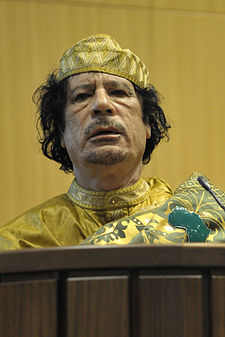
If this was not astonishing enough, the widely denounced behavior of the UN human rights watch dog did not improve over time. The newly reformed Council selected Libya to join the other forty six countries responsible for promoting and protecting human rights around the globe. In May 2010, through a secret ballot, Libya received one hundred and fifty five votes from the one hundred ninety two members of the UN General Assembly.
It was only this past Friday, one year . . .
Read more: Qaddafi and Human Rights
Friday, February 25th, 2011 
For the first time since we have been operating, I felt like the discussions on the blog were getting away from my editorial control. I take this to be a good sign. While there were interesting posts on the economy and economic theory, and on media and media theory, as well as on revolutionary hopes in Egypt, the focus of our discussion this week was on the issues surrounding the events in Madison, Wisconsin, moving in interesting and somewhat unexpected directions.
Anna Paretskaya opened our deliberations, with her “Cairo on the Isthmus.” She presented a bird’s eye view, including some telling photos. I actually found some of the details of her post more interesting than the elements that stimulated heated discussion. Particularly fascinating was how she understood the beginning of the movement as she reported in the opening of her piece:
“What started as a stunt by a group of University of Wisconsin-Madison students to deliver a few hundred “Valentine’s Day” cards from students, staff, and faculty to Governor Scott Walker asking him not to slash the university budget has now become national news: close to 100,000 Wisconsinites have come to the State Capitol in Madison over the past four days to protest the so-called “budget repair” bill…”
This made clear to me Madison, Wisconsin’s connection to Cairo, and Cairo’s connection to the movement I observed around the old bloc, before the fall of the Berlin Wall, and to the Obama campaign and the Tea Party movement. People meet with each other, speak to each other, develop a capacity to act together, create a power that hitherto did not exist. They may or may not reach their political goal, but they change the political landscape as they act. This is what I see as being the most significant consequence of “the politics of small things.” Not only has there been regime change in Egypt and Tunisia, but the Arab world will never be the same after the wave of protests we have observed. And the Republicans may or may not succeed in their battle against public employee unions and the . . .
Read more: DC Week in Review: The Wisconsin Events
Thursday, February 24th, 2011 

The current economic slowdown constitutes a breakdown for advanced capitalism. Its means of allocating capital – financial markets – froze up and would have collapsed completely if governments had not intervened on a massive scale. The rates of growth of output and employment in most industrialized countries are anemic and persistent. Does not the breakdown of capitalism require some fundamental rethinking of its explanation system, aka economic theory? Today’s troubles and the failure of most economists to predict them have given rise to a lively debate within the discipline about the sources of failure of economic theory and the ways in which it should be reformed. This is a good sign. But the current debate among economists is shallow and confined to a tweaking of its existing toolkit. There is no indication that this debate will produce the intellectual revolution needed to respond to the theoretical and policy challenges facing industrialized countries.
The discipline of economics has been no stranger to methodological controversy. The Methodenstreit (debate over method) among German social scientists in the 1880s, the Keynesian revolution in the 1930s, the ‘F-twist’ debate in the 1960s over the importance of realism of assumptions, and the ‘Cambridge controversy’ over the meaning of capital in the 1970s are some of the most notable debates. But not all methodological discussions are created equal. Some are profound—questioning the very structure of the reigning methodology—while others are more superficial, aiming at incremental reform or merely cosmetic change. We find that the current discussion is for the most part quite shallow, and will remain so unless certain voices in the debate are given more emphasis.
The central problem is that almost nobody dares to rethink the nature of economic life and the proper scope of economic thinking. This deeper approach is precisely what we find in the Methodenstreit and in Keynes’ innovations. On its surface the Methodenstreit was a debate over whether concrete historical analysis or mathematical modeling was better suited to explain economics. But this question ultimately rested on the question of what the realm of political . . .
Read more: Waiting for the New Keynes
Wednesday, February 23rd, 2011 

Alexis de Tocqueville thought, as I observed in an earlier post, that after the grand principled politics of the earliest years of the Republic, American parties and politics would be about minor issues. About dividing up the spoils, not about the definition of what democracy is and how it should be enacted. His important insight was to distinguish between two different forms of political contestation. He correctly noted that American politics would be mostly about dividing the spoils, resting upon a general consensus about fundamental principles. But what he missed is that fundamental conflicts have a way, episodically, of reappearing, sometimes quite unexpectedly, and even with a slight of hand. Such is our present situation.
This became clear to me as I was surfing the web this morning and came across a post by Jonah Goldberg at the National Review online. He openly made the move from petit to grand politics in Tocqueville’s sense.
“The protesting public-school teachers with fake doctor’s notes swarming the capitol building in Madison, Wis., insist that Gov. Scott Walker is hell-bent on “union busting.” Walker denies that his effort to reform public-sector unions in Wisconsin is anything more than an honest attempt at balancing the state’s books.
I hope the protesters are right. Public unions have been a 50-year mistake.”
Goldberg argues against the very idea of public employee unions, going a step further than the aggressive Governor of Wisconsin. For Goldberg it is all about the principle, as he supports a politician who must get on with practical political concerns. As Max Weber would put it, Walker uses an apparent ethic of responsibility, fiscal balance, to hide his ultimate ends; attacking the public employees’ unions. Walker governs responsibly, moving toward the principled goal.
But there is more than meets the eye in Goldberg’s essay, which is framed around the idea that unions in the private sector fought a valiant and historic struggle against capitalist exploitation, while public unions just stand for stealing from the public coffers. On the page where his post appears, . . .
Read more: Libertarianism versus Workers’ Rights in Wisconsin
|
A sample text widget
Etiam pulvinar consectetur dolor sed malesuada. Ut convallis
euismod dolor nec pretium. Nunc ut tristique massa.
Nam sodales mi vitae dolor ullamcorper et vulputate enim accumsan.
Morbi orci magna, tincidunt vitae molestie nec, molestie at mi. Nulla nulla lorem,
suscipit in posuere in, interdum non magna.
|
Blogroll
On the Left
On the Right
|

